Understanding pallet rack beam capacity is essential for maintaining warehouse pallet rack safety, protecting inventory, and ensuring structural integrity. However, determining safe load limits involves more than calculating pallet weights or consulting manufacturer capacity charts.
Pallet rack capacity ratings must be established through proper engineering assessments that account for rack configuration, load distribution, anchoring, and seismic requirements. Proper engineering documentation, accurate capacity ratings, and mandatory load signage help Ontario warehouses maintain compliant, safe, and reliable storage systems.
What Is Pallet Rack Beam Capacity?
Pallet rack beam capacity is the maximum load a single beam level can hold under specified conditions, such as beam length, load configuration, and the number of pallets per level. It differs from upright frame capacity (the vertical columns), rack bay capacity (one full section of shelving), and total system capacity (the entire structure).
Manufacturers test and rate each component individually, so warehouses must follow the documented ratings rather than estimate based on appearance.
How Is Pallet Rack Capacity Determined?
Rack capacities must account for the complete system design, installation conditions, and applicable building code requirements. Under Ontario’s Building Code, storage racks, including their anchorage, must be designed to withstand applicable loads. Seismic considerations also play an important role in determining structural requirements.
A qualified professional engineer must assess the relevant design conditions and establish the appropriate load capacities for the installed racking system.
The assessment may consider:
- Rack configuration. Beam lengths, upright frames, bracing, connections, and overall rack geometry.
- Seismic requirements. Site-specific seismic design considerations and the effects of earthquake forces on the rack structure.
- Anchoring and flooring. Anchor specifications, floor conditions, and the structural capacity of the supporting slab.
- Load distribution. Pallet weights, load positioning, beam loading, and the cumulative weight across rack levels.
- Component specifications. Manufacturer specifications, material properties, and compatibility between rack components.
Manufacturer capacity charts may provide useful component information, but generic charts alone should not be used for calculating pallet rack beam capacity.
What Documentation Is Required for Pallet Rack Capacity in Ontario?
Ontario warehouses must maintain engineering and safety documentation confirming that pallet racking meets applicable requirements.
Depending on the system, businesses need either a sealed, stamped Pre-Start Health and Safety Review (PSR) prepared by a professional engineer, outlining structural adequacy and capacity ratings, or manufacturer documentation establishing a PSR exemption.
Exemption documentation may include compliance statements, capacity ratings, structural drawings, and installation instructions. Businesses must keep all applicable documentation accessible in the workplace.
Pallet Rack Beam Capacity and Warehouse Safety Requirements in Canada
Provincial and territorial occupational health and safety regulations require racking systems to be maintained within rated limits. Maintaining current capacity documentation and visible rack load signage helps staff store inventory correctly.
In addition, routine pallet rack inspection requirements should include checks for bent beams, loose connectors, and anchor integrity, supported by a documented maintenance schedule.
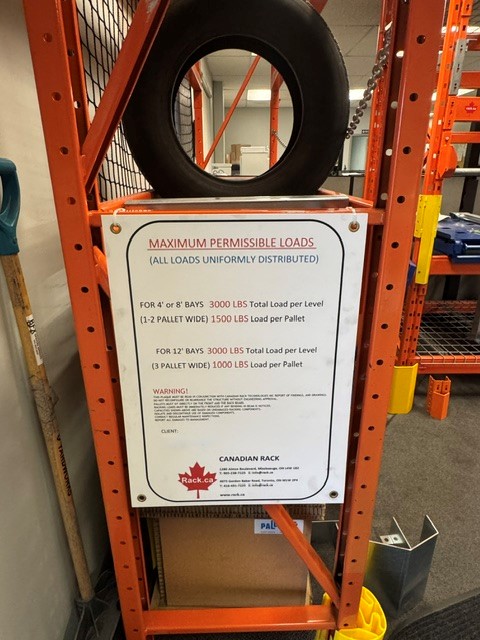
Ontario’s Building Code also requires permanent capacity signage in conspicuous locations on pallet racking systems. Signs must clearly display the maximum permissible design loads for each shelf and rack storage system. Businesses should ensure that posted ratings reflect the capacities established through the appropriate engineering assessment or supporting manufacturer documentation.
How to Choose the Right Pallet Racking System for Your Warehouse
Match racking capacity to your actual inventory weight and dimensions, with a safety margin for future growth. Beyond capacity, consider how warehouse storage solutions and warehouse safety accessories, including guarding, anchoring hardware, and clearly displayed capacity signage, can optimize space without compromising safety.
Frequently Asked Questions About Pallet Rack Beam Capacity
How is pallet rack capacity determined?
Pallet rack capacity must be established using the appropriate engineering assessment and applicable design requirements. An engineer considers factors such as rack configuration, beam and upright specifications, anchoring, seismic loads, and load distribution to establish the allowable capacities of the installed system.
Is pallet rack beam capacity the same as rack bay capacity?
No. Beam capacity applies to a single level, while bay capacity accounts for the combined load across all levels in that section.
Is pallet rack capacity signage mandatory in Ontario?
Yes. Ontario’s Building Code requires permanent signage in conspicuous locations indicating the maximum permissible design loads for each shelf and rack storage system.
Who can determine pallet rack capacity?
A qualified professional engineer can assess the racking system and establish its allowable capacities based on its design, installation, and applicable building code requirements.
Why Choose Canadian Rack Technologies for Warehouse Storage Solutions?
Determining pallet rack capacity involves more than consulting manufacturer charts or calculating individual pallet weights. Proper engineering assessments, accurate capacity documentation, and clearly displayed load ratings are essential for any warehouse racking installation.
Canadian Rack Technologies has an in-house engineer who can assess your racking system, determine its allowable capacities, and provide sealed, stamped Pre-Start Health and Safety Review (PSR) documentation where required. Our team can also help you understand your documentation requirements and ensure your racking systems have the appropriate capacity ratings. Contact Canadian Rack Technologies today to learn more about our pallet racking solutions in Canada.

About: Kevin Ausman
Kevin Ausman is the founder of Canadian Rack Technologies. He has over 30 years of experience in providing safe and efficient turn-key storage solutions and he specializes in pallet racking, pick systems, industrial shelving, mezzanines, cantilever racks, and more. Kevin is dedicated to providing great customer service, listening to client’s needs, and supplying the best products available.